
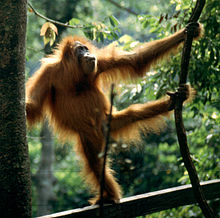
The Sumatran orangutan (Pongo abelii)
is one of the two species of orangutans. Found only on the island of
Sumatra, in Indonesia, it is rarer and smaller than the Bornean
orangutan. The Sumatran orangutan grows to about 1.4 metres (4.6 ft)
tall and 90 kilograms (200 lb) in males. Females are smaller, averaging
90 centimetres (3.0 ft) and 45 kilograms (99 lb).
Compared
with the Bornean orangutan, the Sumatran orangutan tends to be more
frugivorous and especially insectivorous. Preferred fruits include figs
and jackfruits. It will also eat bird eggs and small vertebrates.
Sumatran orangutans spend far less time feeding on the inner bark of
trees.
Wild
Sumatran orangutans in the Suaq Balimbing swamp have been observed
using tools. An orangutan will break off a tree branch that is about a
foot long, snap off the twigs and fray one end. It then will use the
stick to dig in tree holes for termites. They will also use the stick to
poke a bee's nest wall, move it around and catch the honey. In
addition, orangutans use tools to eat fruit. When the fruit of the
Neesia tree ripens, its hard, ridged husk softens until it falls open.
Inside are seeds that the orangutans enjoy eating, but they are
surrounded by fiberglass-like hairs that are painful if eaten. A
Neesia-eating orangutan will select a five-inch stick, strip off its
bark, and then carefully collect the hairs with it. Once the fruit is
safe, the ape will eat the seeds using the stick or its fingers.
Although similar swamps can be found in Borneo, wild Bornean orangutans
have not been seen using these types of tools.

NHNZ
filmed the Sumatran orangutan for its show Wild Asia: In the Realm of
the Red Ape; it showed one of them using a simple tool, a twig, to pry
food from difficult places. There is also a sequence of an animal using a
large leaf as an umbrella in a tropical rainstorm.
The
Sumatran orangutan is also more arboreal than its Bornean cousin; this
could be because of the presence of large predators like the Sumatran
Tiger. It moves through the trees by brachiation.
Life cycle
The
Sumatran orangutan is more social than its Bornean counterpart. Groups
of these orangutans gather to feed on the mass amount of fruiting on the
fig trees. However adult males generally avoid contact with other adult
males. Sub-adult males will try to mate with any female, though they
probably mostly fail to impregnate them since mature females are easily
capable of fending them off. Mature females prefer to mate with mature
males.
The
average interbirth rates for the Sumatran orangutan is 9.3 years – the
longest reported among the great apes, including the Bornean orangutan.
Infant orangutans will stay close to their mother for up to three years.
Even after that, the young will still associate with their mother. Both
orangutan species are likely to live several decades; estimated
longevity is more than 50 years. The average of the first reproduction
of P. abelii is around 15.4 years old. There is no indication of
menopause.

The
Sumatran orangutan is endemic to Sumatra island and is particularly
restricted to the north of the island. In the wild, Sumatran orangutans
survive in the province of Nanggroe Aceh Darussalam (NAD), the
northernmost tip of Sumatra. The primate was once more widespread, as
they were found more to the south in the 19th century such as in Jambi
and Padang. There are small populations in the North Sumatra province
along the border with NAD, particularly in the Lake Toba forests. A
survey in the Lake Toba region found only two inhabited areas, Bukit
Lawang (defined as the animal sanctuary) and Gunung Leuser National
Park. The species has been assessed as critically endangered on the IUCN
Red List since 2000. It is considered one of "The World's 25 Most
Endangered Primates."
A
survey in 2004 estimated that around 7,300 Sumatran orangutans still
live in the wild. Some of them are being protected in five areas in
Gunung Leuser National Park; others live in unprotected areas: northwest
and northeast Aceh block, West Batang Toru river, East Sarulla and
Sidiangkat. A successful breeding program has been established in Bukit
Tiga Puluh National Park in Jambi and Riau provinces.
Nonja,
thought to be the world's oldest in captivity or the wild at the time
of her death, died at the Miami MetroZoo at the age of 55.


Tidak ada komentar :
Posting Komentar